
Use menue on left or select name.

The walk down a small gorge was scenic and interesting, a bit like the lower part of some gorges in Crete. By a small artificial pond there were dragonflies and a species of kingfisher that I have seen before in the tropics. The main attraction was a huge baobab tree which l could just get in a photograph with my super wide-angle lens.
17 Photos
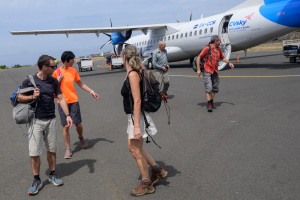
After a long wait for the plane to Fogo we changed islands in order to experience the largest volcano of Cabo Verde. The long drawn-out tour of the colourfully painted ex-colonial town of São Filipe was thankfully punctuated by a sort stop at a pizzeria apparently belonging to a namesake of mine. There were views of the smaller island of Brava partially enveloped in cloud.
26 Photos

On the walk although it was quite hot some vines were to be seen growing in the lava as on Lanzarote. Remains of other crops such as beans, lemons and avocados could also be seen. At the top we split into 2 equally sized groups, the older and the younger ones. The younger ones went down a lava tunnel and we met them again later. We were not actually split into groups by age but it turned out that way based on what the local guide’s assessment of us.
27 Photos

Pico de Fogo, the largest active volcano in the region, has an eight-kilometre-diameter caldera the base of which is at an elevation of 1,800 metres and an interior cone that rises to 2,829 metres above sea level. This form is similar to but somewhat smaller than that of Mount Teide on Tenerife in the Canary Islands.. The caldera resulted from subsidence, following the partial evacuation (eruption) of the magma chamber, along a cylindrical column from within the magma chamber at a depth of 8 kilometres. Only 4 group members started very early in the morning in order to climb to the summit of the Pico de Fogo accompanied by a local guide.
20 Photos

Praia, situated on the southern shore of Santiago Island, is the capital of Cabo Verde. A large bronze statue portrays Diogo Gomes, who had accompanied António de Noli on his voyage of discovery of the islands, and who claimed to have been the first to land on Santiago and the first to name the island. Next to his statue a plaque records that Santiago was the first stop of Charles Darwin's voyage with HMS Beagle in 1832.
17 Photos

Santo Antao is the major island for walking and we were staying there for 3 nights. It is much greener than the other islands because of mists from the North bringing moisture and the scenery on the way to Alto Mira was fantastic. Two of us opted out of the steep and strenuous descent to Cha de Morte but walked along accompanied by our minibus to the nearby settlement of Cha Queimado which is perched on a ridge in the Mira Valley.
25 Photos

We awoke to the spectacular views from our rooms and enjoyed an excellent breakfast right by the sea. Our minibus driver brought us back through the hills to Ribeira Grande and then along the coast to the green valley of Paul for our next hike. The green consists largely of tropical crops of all kinds such as banana, mango, sugarcane, papaya and pepper. These are grown on the smallest of ledges reached by narrow rocky paths.
28 Photos

This was to be the last real walk. The grand finale. There were to be 3 groups: supermen, normal mortals and tortoises. I was in the latter of course. I did not expect to get very far but according to my guide book should still get a good view along the North coast. I did not want to have any stress but feel comfortable and enjoy the day. In the end I was alone which was ideal because I could do what I liked. After the others had gone I set off for the village of Cruzinna de Garcia, which already gives great views along the coast and back to our eco-lodge.
30 Photos

Early in the morning we started the drive back to Porto Novo on the South coast, first along the familiar route to Ribeira Grande and Paul, but then on a newly constructed road close to the coast across the desert like Southern part of the island. There was no comparison with the scenic mountain route of the outward journey. The return ferry ride to Mindelo on Sao Vicente, was fine being much less crowded than last time, perhaps because it was not at the weekend. We soon arrived again at the Hotel Oásis Atlantico Porto Grande where we had some free time.
13 Photos
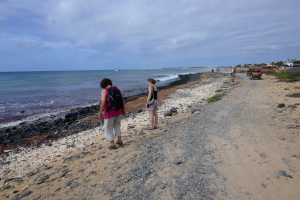
The Hotel Buhda complex looks greener than the surrounding land. It is of course watered and some parts of the lawns are artificial. It would be nice to float in the attractive pool for the next two days. There were no more walks planned, but I walked to the main part of the beach with three others of the group. At last a proper beach, as one imagines it. It was very pleasant with golden sand and the sea had only a slight swell and a very gradual increase in depth. There were lots of other people but not too many. After my swim I had a pizza lunch and slowly returned to the hotel.
17 Photos

On this last day before the night flight back home I walked with two ladies of the group to the smaller of the 2 salt farms on this island of Sal. It is interesting to see how the salt which dries in shallow pools is collected into little pyramids and balls. Then we crossed some sand dunes to reach the coast. However despite the sandy shore the water was full of rocks so that no swimming was possible. I had dinner in the hotel for a second time and it was then not long till we had to leave for the airport at 10.30pm. On arriving in Zürich it felt like winter compared with Capo Verde.
25 Photos

Cabo Verde is an island country and archipelagic state in the central Atlantic Ocean off the coast of West Africa. It consists of ten volcanic islands with a combined land area of about 4,033 square kilometres (1,557 sq mi). These islands lie between 600 and 850 kilometres (370 and 530 miles) west of Cap-Vert, the westernmost point of continental Africa, after which it is named.
10 Photos